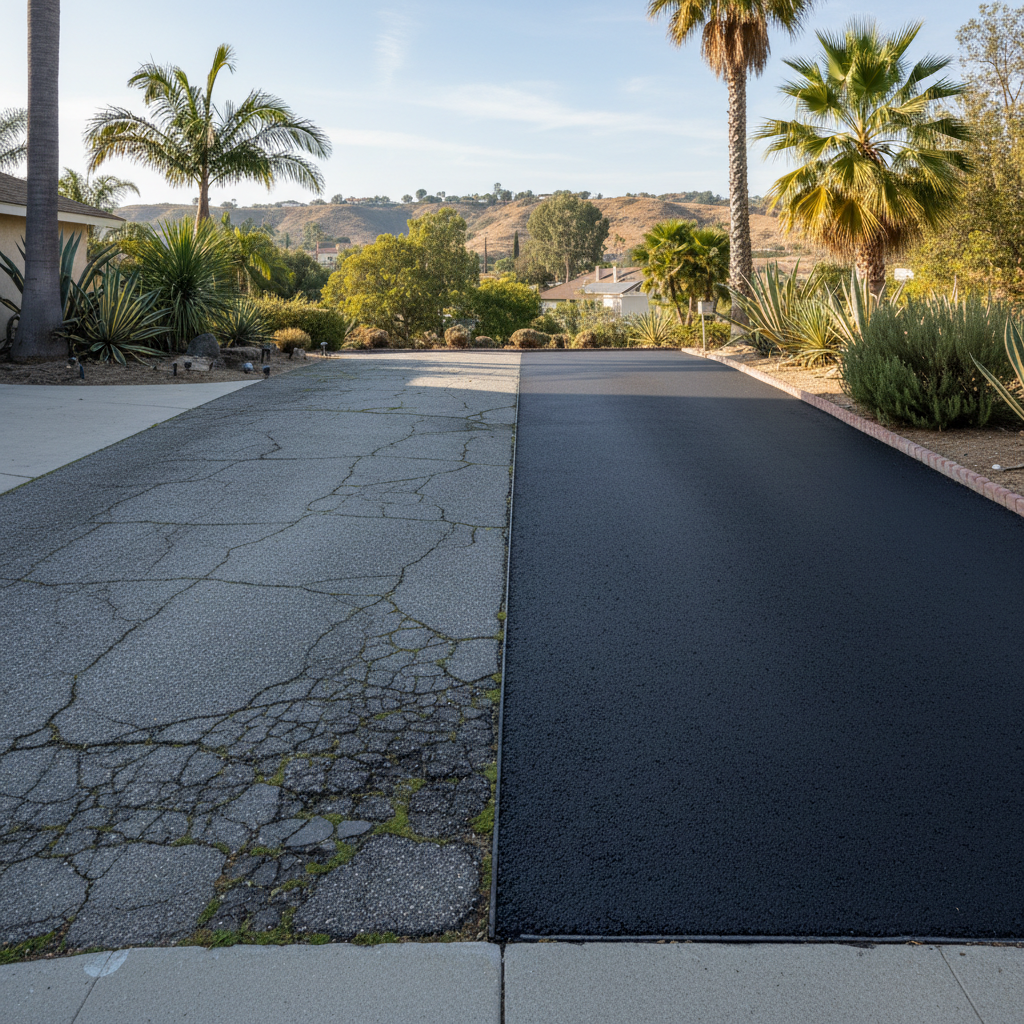
Deciding what to do with a damaged residential driveway always comes down to a battle between your budget and the condition of the pavement. If you own a home near Victory Boulevard or closer to the arts district, you know how fast our Valley heat cycles can warp asphalt. When homeowners call Midway Asphalt Solutions trying to figure out their next move, the debate usually boils down to two choices: tearing it out for a full-depth paving job or laying down a fresh asphalt overlay.
The Real Cost Difference
Let us talk about numbers straight out of the gate. A complete removal and replacement means heavy machinery rips out the old sub-base, fixes whatever soft clay soil is hiding underneath, and lays down brand-new crushed aggregate before the hot mix goes on. That costs real money. An overlay, on the other hand, skips the demolition phase. We clean the existing surface, tack it down, and roll two inches of fresh asphalt right over the top. Naturally, the overlay is cheaper upfront. But if your sub-grade has failed and your car is already bumping over deep alligator cracks, saving money on an overlay is just wasting cash because the underlying structural issues will punch right back through that new layer within a couple of winters.
Durability Under the San Fernando Sun
North Hollywood gets very hot during July and August. Asphalt acts like a solar sponge, soaking up thermal energy and softening up under heavy vehicle tires. If you have a full-depth installation done correctly with proper compaction, the pavement handles that thermal expansion much better because the structural depth is uniform. Overlays can be a bit more sensitive to conditions. If the bonding layer fails between the old, brittle asphalt and the new hot mix, shifting and rutting will happen. That said, a professional overlay on a structurally sound base can easily give you another decade or more of solid parking.
Maintenance and Curb Appeal
Fresh asphalt looks very clean. That rich, dark black finish instantly improves the front of any Valley property. Maintenance requirements do not change much regardless of which route you choose. Homeowners still need to schedule sealcoating every few years to keep UV rays from stripping the oils out of the binder. If you go with an overlay, you keep your existing driveway grades and apron transitions. A full replacement lets Midway Asphalt Solutions correct annoying drainage pooling issues that tend to trap water near your garage door during those rare heavy downpours we get in Southern California. Think about how your current driveway handles water before making your final call.